


Bringing value into “Bloom,” and opening the way to a sustainable society through “Future Abundance”
From our founding aspiration to a next-generation internet company
From the day in 1999 when i-mode appeared and mobile phones became the gateway to the internet, the mobile internet market expanded explosively. In 2004, Osaifu-Keitai began connecting the digital world and real life in real time.
In 2005, when the term “O2O (Online to Offline)” did not yet even exist, I founded CERES to be the bridge connecting these two worlds and began providing mobile point services.
“To connect the value of the internet world with the value of the real world”
CERES, which set out under this ideal, marked its 21st year since founding in 2026. Today “Moppy,” our core service, has grown into a service used by a cumulative total of more than 14 million people. But our challenge does not stop here. We are now deepening our end-to-end “vertically integrated model” that extends to D2C by leveraging our media strength, while positioning “blockchain technology” — the greatest revolution since the internet — as next-generation social infrastructure and advancing the construction of a platform that drives the vitalization of the digital economy.
Toward a future in which business growth and environmental conservation go hand in hand
For CERES, sustainability initiatives are not merely a response to risk. They are part of our strategy for achieving discontinuous growth.
In July 2025 we declared our commitment to obtaining SBT certification, and in the 2025 CDP climate change score we achieved a “B” score. In April 2026 we were selected for the “A List,” the highest rating in CDP's Supplier Engagement Assessment, demonstrating that our climate action across the entire value chain is world-class. Furthermore, in June 2026 we obtained SBT certification, putting us in a position to take concrete action on climate change across the entire value chain under science-based targets.
We will demonstrate leadership toward our partner companies and contribute to a future in which economic growth and the conservation of the global environment go hand in hand.
Building firm ground that supports each individual’s “Blossoming”
Toward realizing our mission of “Nurturing potential, enriching the future,” our greatest capital is people. Our aim is to bring the five values held by each employee — Essence, Challenge, Circulation, Immersion, and Emotion — into their fullest bloom. To that end, we are using our broadly diversified businesses to build ground on which professionals can hone their expertise, while at the same time devoting ourselves to creating an organization in which anyone can keep pouring in their passion, regardless of changes in life stage.
As milestones along the way, in February 2026 we obtained “Platinum Eruboshi” certification under the Act on the Promotion of Women's Active Engagement, and we are accelerating preparations toward obtaining “Platinum Kurumin,” which recognizes advanced support for balancing work and childcare. We have also set the acquisition of “Certified Health & Productivity Management Outstanding Organization (White 500)” and “Excellent Enterprise of Safety and Health” certifications as milestones, and have built thorough mental health care and our own childcare support system that goes beyond public support.
That employees are “healthy in both body and mind, and able to combine a fulfilling private life with taking on challenges.” We are convinced that only on this unshakeable ground can we build an organization that is resilient to change and highly competitive.
Toward enriching the world
The name CERES, derived from the Roman goddess of the harvest, embodies the aspiration we have held since our founding: to provide new value to society and to realize an affluent world.
By combining the strong business development capability we have cultivated with discontinuous growth through strategic M&A, CERES will continue to believe in the power of the internet and, together with our stakeholders, create a society of "Future Abundance" in which value blossoms in an ever-widening chain.
June 2026
Ceres Inc.
Satoshi Takagi, President and Representative Director
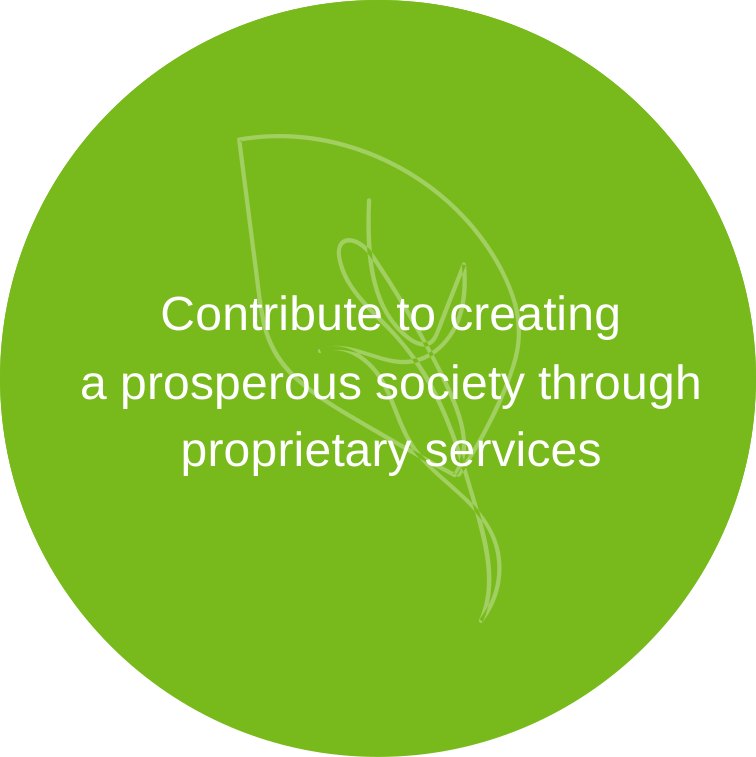
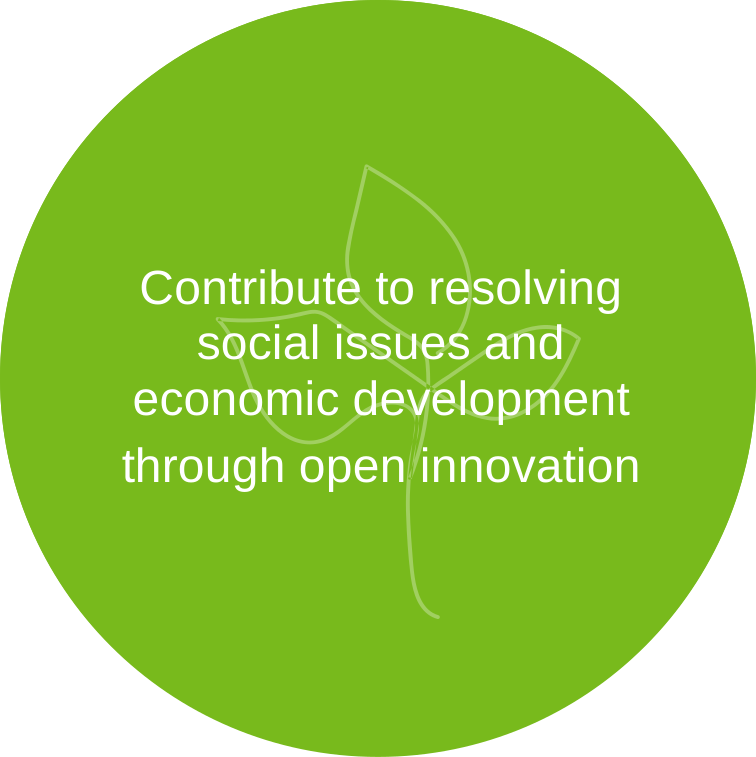
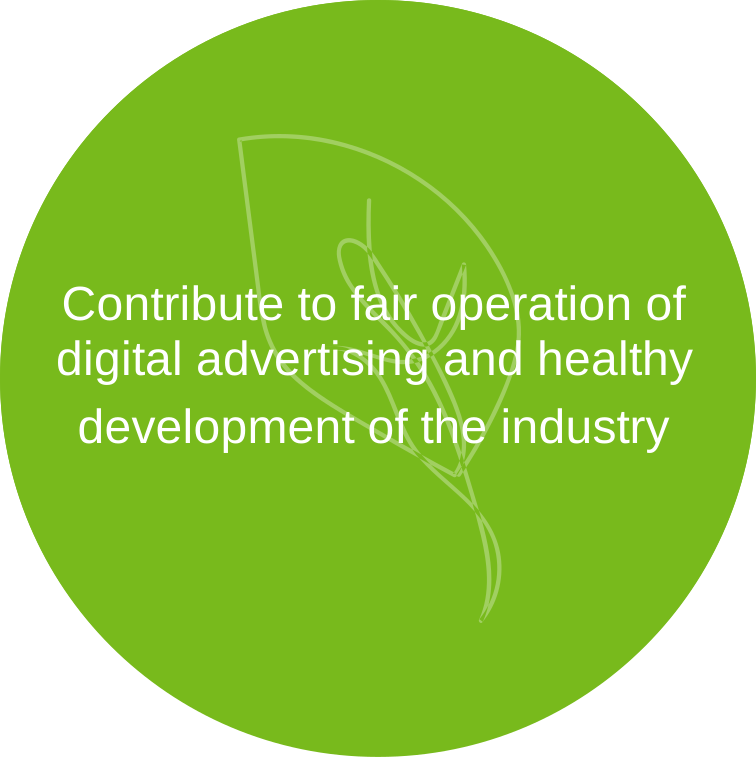
To help resolve sustainability challenges, Ceres introduced Seven Materialities as themes to focus on towards more effectively allocating company resources.


We identified social challenges closely related to our business activities by
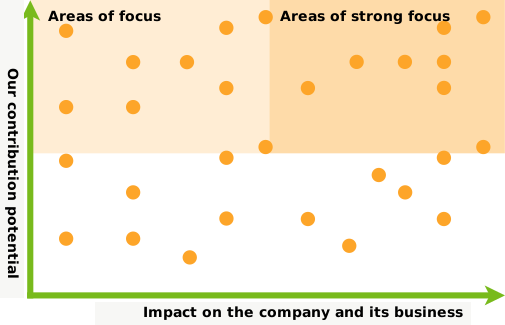
referring to global frameworks of sustainability. We then assessed and mapped out the social
challenges based on their "impact on the company and its business activities" and "potential
contributions by the company" to identify materialities.
Assuming that stakeholder interest
in each social challenge is equally high, we classified the mapped out challenges by theme,
including in the areas where we can effectively make a contribution using our resources. Then we
set them as materialities.
Among these social challenges, we acknowledge that problems with a
high impact on the company and its business are areas that we should keep a particular focus on
as our themes.
Once a year, our Sustainability Promotion Committee identifies social
challenges, evaluates the risks and opportunities related to them, configures and reviews
materialities, examines specific measures, and reviews the results of our achievements.
The
identified risks and opportunities are shared with the Risk Management Committee and are then
assessed comprehensively with other risks and opportunities.
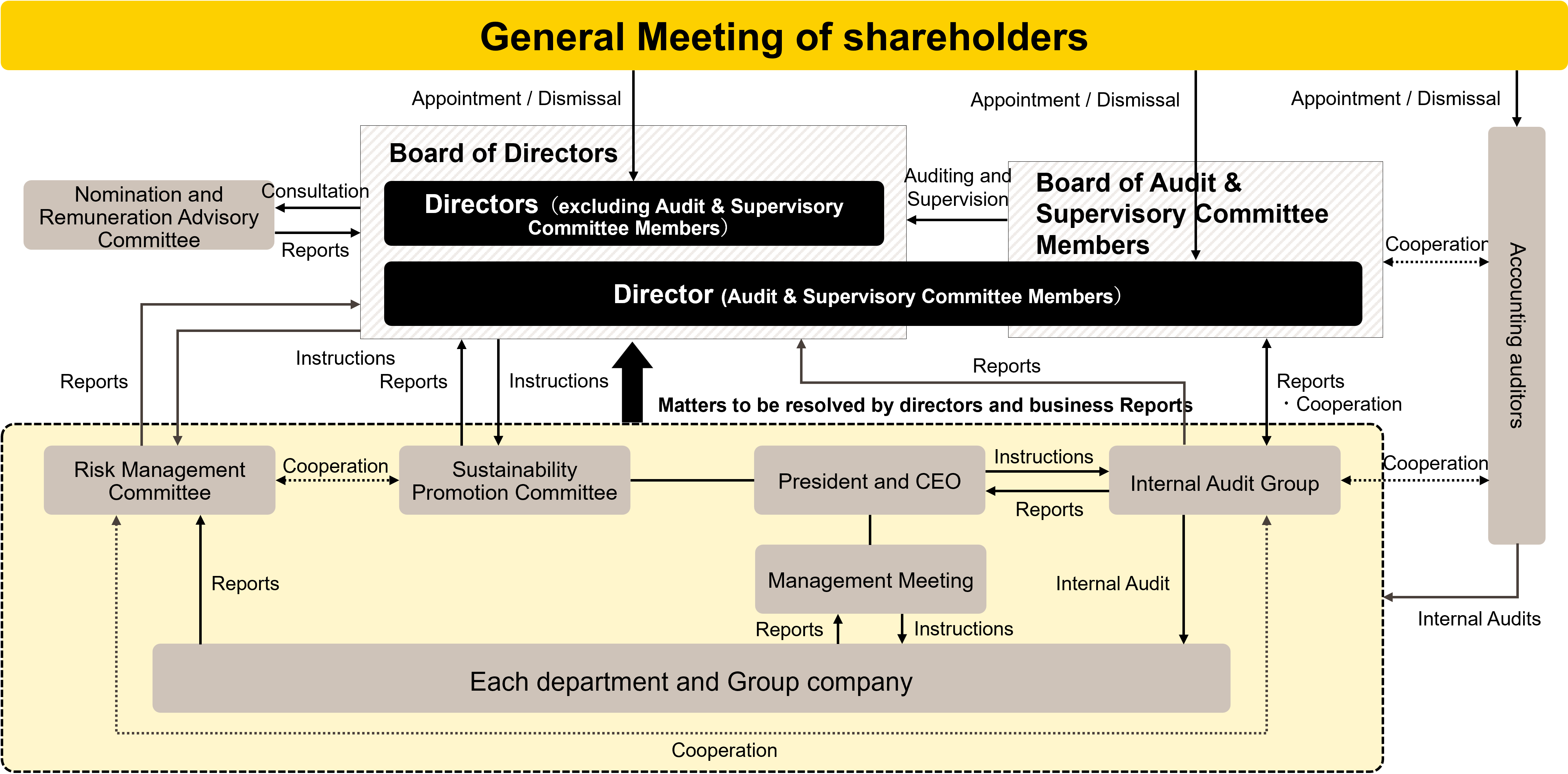
The Sustainability Promotion Committee is chaired by the President and Representative Director. It
is made up of internal directors, executive officers, and representative directors of major
group companies. It also consists of outside directors, as well as directors who are members of
the audit and supervisory committee. The Committee also includes other members deemed necessary
by the Committee as observers. The Committee meets once a year in principle.
This Committee
makes recommendations and reports to the Board of Directors on the promotion of Ceres's
sustainability business strategies and decides policies and measures. It also presents results
on examinations of matters relating to materiality, progress reviews and deliberations on
improvement plans.